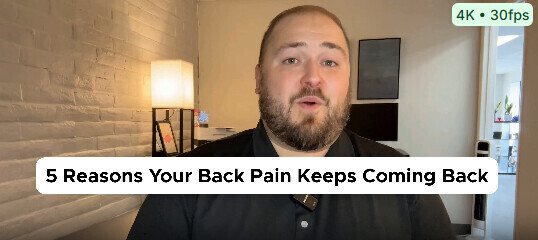
Why Does My Back Pain Keep Coming Back?
The 5 Most Common Reasons Your Back Pain Returns Again and Again
If you've ever found yourself saying...
"I was finally starting to feel better...then I bent over to pick something up and my back went out again."
You're not alone.
Recurring back pain is one of the most common reasons people come into our office.
The frustrating part isn't just the pain—it's not knowing why it keeps happening.
Many people begin wondering if it's simply because they're getting older, if they'll have to live with it forever, or if surgery is inevitable.
The good news is that recurring back pain often has an explanation.
In many cases, the underlying problem simply hasn't been identified and corrected.
Let's look at the five most common reasons we see back pain continue to come back.
1. You're Treating the Pain Instead of the Cause
Most people naturally focus on getting rid of the pain as quickly as possible.
They take pain medication.
Use a heating pad.
Ice their back.
Stretch.
Book a massage.
Rest for a few days.
There's nothing wrong with trying to feel better.
The problem is that these treatments often address the symptom—not the reason the symptom developed.
Imagine your smoke alarm starts going off because there's a fire in your kitchen.
You remove the batteries.
The alarm stops.
But the fire is still burning.
Pain works much the same way.
When we only focus on reducing symptoms without understanding why they're happening, the problem often continues beneath the surface.
That's why so many people experience temporary relief followed by another flare-up weeks later.
2. Your Body Has Started Compensating
Your body is incredibly good at adapting.
If one joint isn't moving properly...
Another joint starts working harder.
If one muscle becomes weak...
Another muscle takes over.
These compensations help you continue functioning for a while.
Eventually, though, they create new problems.
Someone with low back pain may eventually notice:
-
Hip pain
-
Tight hamstrings
-
Pain between the shoulder blades
-
Neck stiffness
-
Frequent headaches
Many people assume they have multiple unrelated problems.
Often they're connected.
The pain you're feeling today isn't always where the problem originally began.
That's why finding the source of the dysfunction is so important.
3. Your Daily Habits Keep Recreating the Problem
Even the best treatment has a difficult time competing with unhealthy habits repeated every single day.
Think about how much time most of us spend:
-
Sitting at a computer
-
Driving
-
Looking down at our phones
-
Lifting improperly
-
Sleeping in awkward positions
-
Standing with poor posture
None of these habits seem significant on their own.
But over months and years, they place repeated stress on the same joints and muscles.
Small daily habits create big long-term outcomes.
The encouraging news is that small improvements in your daily movement can have an equally powerful effect over time.
4. You're Feeling Better...But You Haven't Fully Recovered
This is one of the biggest mistakes we see.
Pain often disappears before your body has completely recovered.
As soon as people start feeling better, they naturally return to normal activities.
They stop doing their exercises.
They stop stretching.
They stop paying attention to posture.
Unfortunately, the muscles may still be weak.
The joints may still be restricted.
Movement patterns may still be dysfunctional.
Without fully restoring normal movement, it's much easier for another flare-up to happen.
Feeling better doesn't always mean you've fully healed.
5. You Never Found Out Why It Started
This is probably the biggest reason recurring back pain continues.
Many people spend months—or even years—trying different treatments without ever receiving a clear explanation of what's actually causing their pain.
Without understanding the cause, every treatment becomes guesswork.
When you understand why your body hurts, you can begin making informed decisions instead of simply hoping the next treatment works.
Knowledge creates confidence.
Confidence leads to better decisions.
And better decisions often lead to better outcomes.
How We Approach Recurring Back Pain at Central Chiropractic
Our goal isn't simply helping patients feel better for a few days.
We want people to understand:
-
Why their pain developed
-
What's preventing it from improving
-
How their body has adapted or compensated
-
What needs to change to restore healthy movement
-
How to reduce the chances of future flare-ups
Every patient receives an individualized evaluation because no two people move exactly the same.
The better we understand your body, the more specific—and effective—your care can be.
When Should You Get Your Back Evaluated?
You don't have to wait until you can barely get out of bed.
If any of these sound familiar, it's probably time to find out what's actually going on:
-
Your back pain keeps returning every few weeks or months.
-
Stretching only helps temporarily.
-
You're relying on pain medication just to get through the day.
-
You're avoiding activities because you're afraid your back will "go out."
-
You're waking up stiff most mornings.
-
You're tired of guessing what's wrong.
Early evaluation often helps prevent small problems from becoming much larger ones.
The Bottom Line
Recurring back pain is not something you should simply accept as part of getting older.
Many people return to exercising, golfing, traveling, working comfortably, and enjoying time with their families after identifying and addressing the underlying cause of their pain.
The first step isn't finding another temporary fix.
It's understanding why your pain keeps coming back.
Once you know the cause, you can make informed decisions about the best path forward.
Ready to Get Answers?
If recurring back pain has been affecting your work, sleep, exercise, or daily life, we'd love to help.
At Central Chiropractic, we'll perform a thorough evaluation, explain exactly what we find, answer your questions, and develop a personalized plan designed to help you move better, feel better, and stay active for the long term.
You don't have to keep guessing why your back hurts. Let's find the root cause together.

Caleb Bryant
Contact Me
%20-%202026-07-23T164307.914.jpg)